Policy gradient algorithms have been successfully applied to enhance the reasoning capabilities of large language models (LLMs). KL regularization is ubiquitous, yet the design surface — choice of KL direction (forward vs. reverse), normalization (normalized vs. unnormalized), and estimator (k1/k2/k3) — is scattered across the literature and often intertwined with off-policy estimation. We ask a focused question: under the off-policy setting, what weighting is required for each KL variant so that the surrogate we optimize yields the exact gradient of the intended KL-regularized objective? We answer this with a compact, unified derivation we call the Regularized Policy Gradient (RPG) view. RPG (i) unifies normalized and unnormalized KL variants and shows that the widely-used k3 penalty is exactly the unnormalized KL; (ii) specifies conditions under which REINFORCE-style losses with stop-gradient are gradient-equivalent to fully differentiable surrogates; (iii) identifies and corrects an off-policy importance-weighting mismatch in GRPO’s KL term; and (iv) introduces RPG-Style Clip, a clipped-importance-sampling step within RPG-REINFORCE that enables stable, off-policy policy-gradient training at scale. On mathematical reasoning benchmarks (AIME24, AIME25), RPG-REINFORCE with RPG-Style Clip improves accuracy by up to +6 absolute percentage points over DAPO.
Abstract
Regularized Policy Gradient
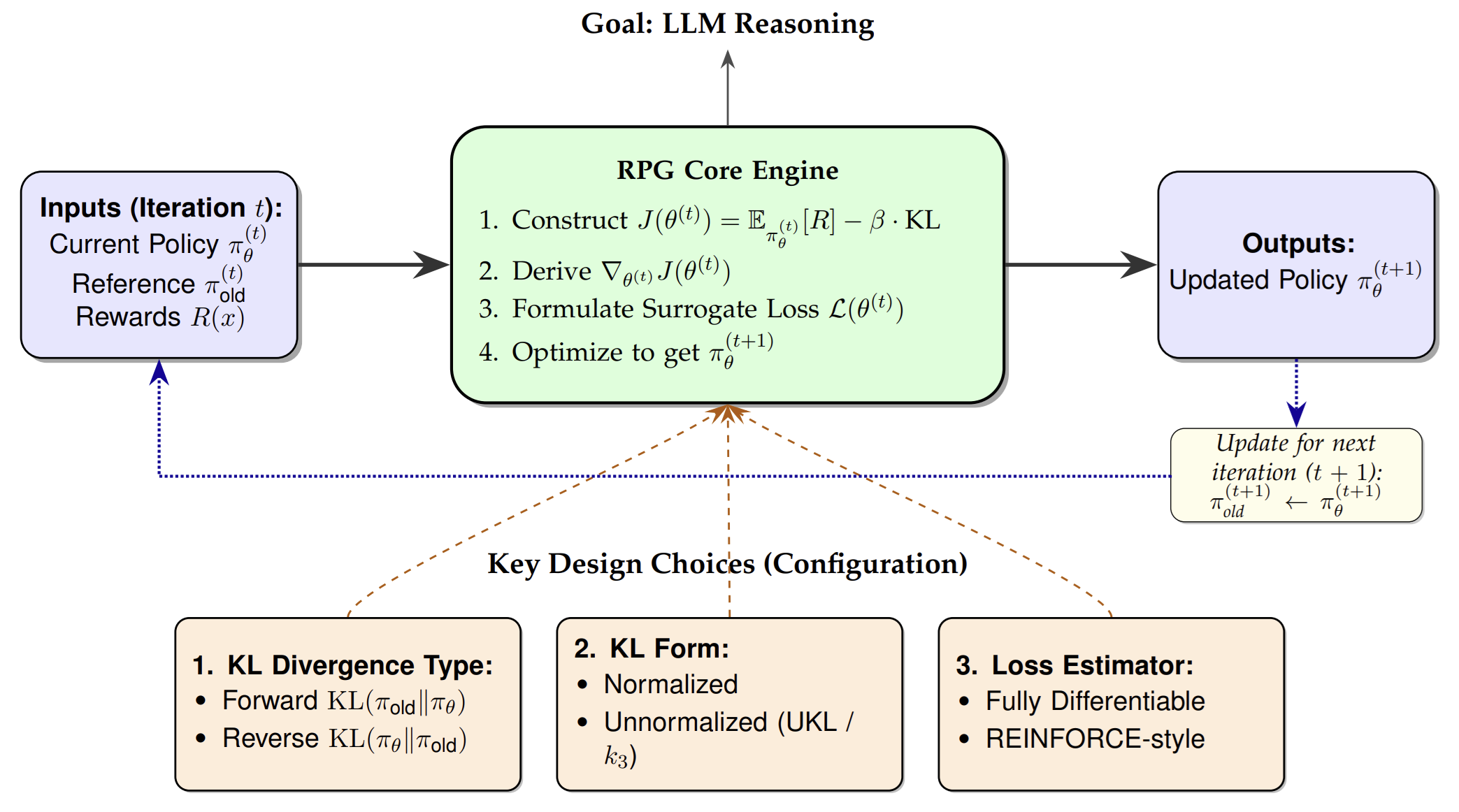
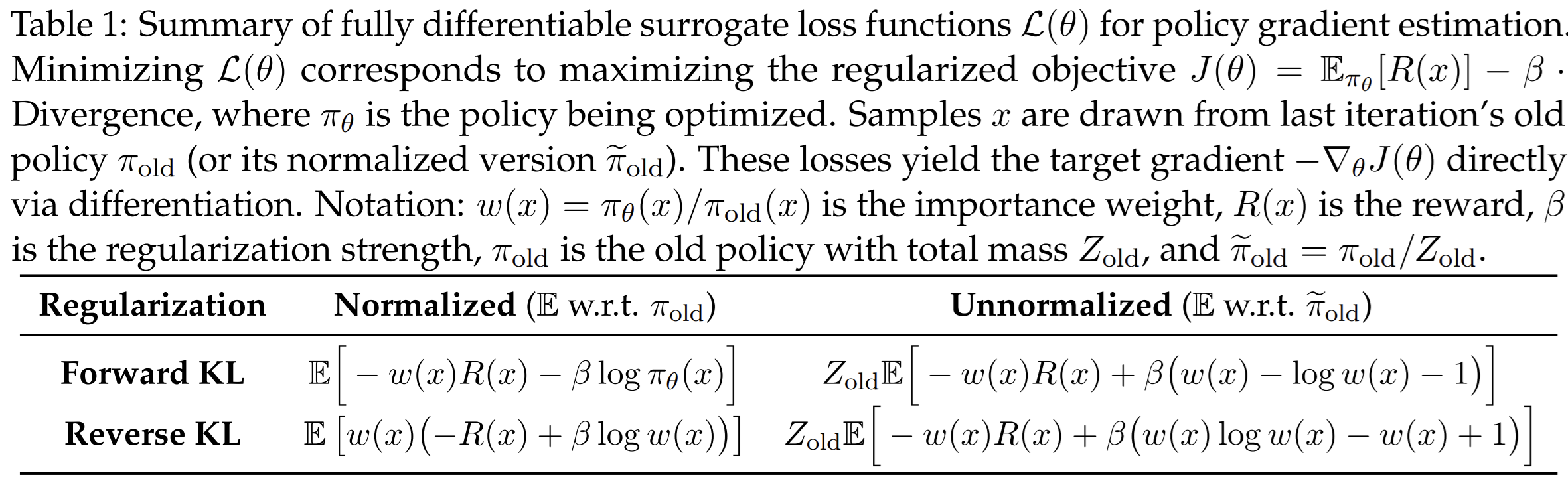
- We derive policy gradients and corresponding surrogate losses for Forward/Reverse KL, in normalized (KL) and unnormalized (UKL) forms, under off-policy sampling with importance weights.
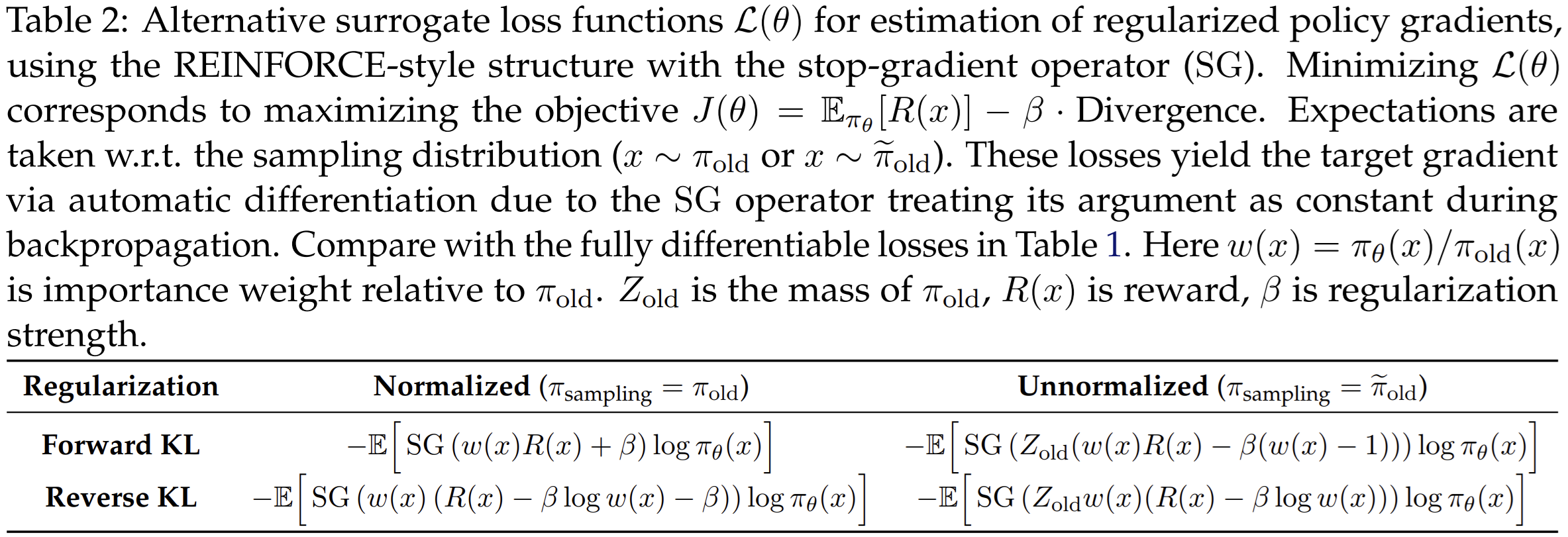
- We give both fully differentiable surrogates and REINFORCE-style losses (with stop-gradient) and prove their gradient-equivalence to the intended regularized objective.
- We introduce RPG-Style Clip, a clipped-importance-weighted REINFORCE estimator that substantially improves stability and variance control while preserving the RPG gradients.
- We reveal the equality between the k3 estimator and unnormalized KL, and show that GRPO’s KL penalty omits an essential importance weight under off-policy sampling; we provide a corrected estimator and loss.
- We present an iterative training framework that periodically updates the reference model to satisfy KL constraints while allowing the policy to depart meaningfully from the initial checkpoint.
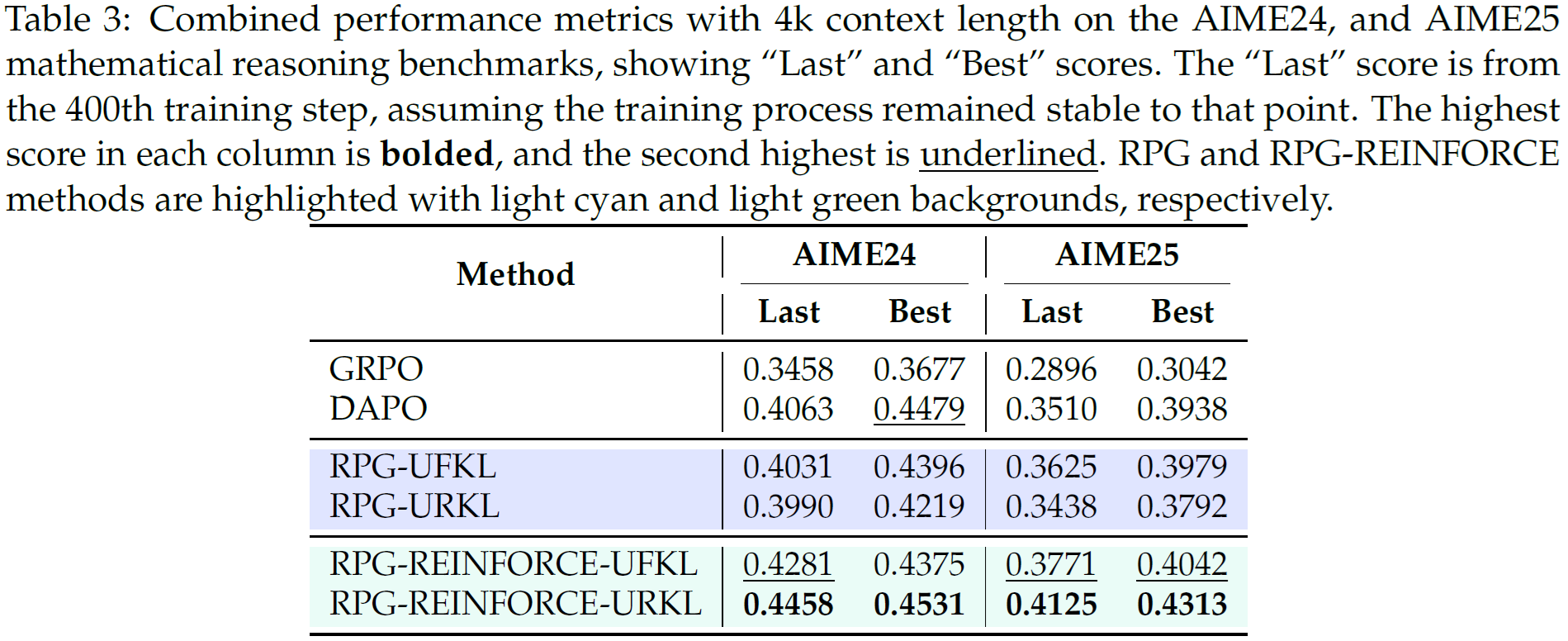
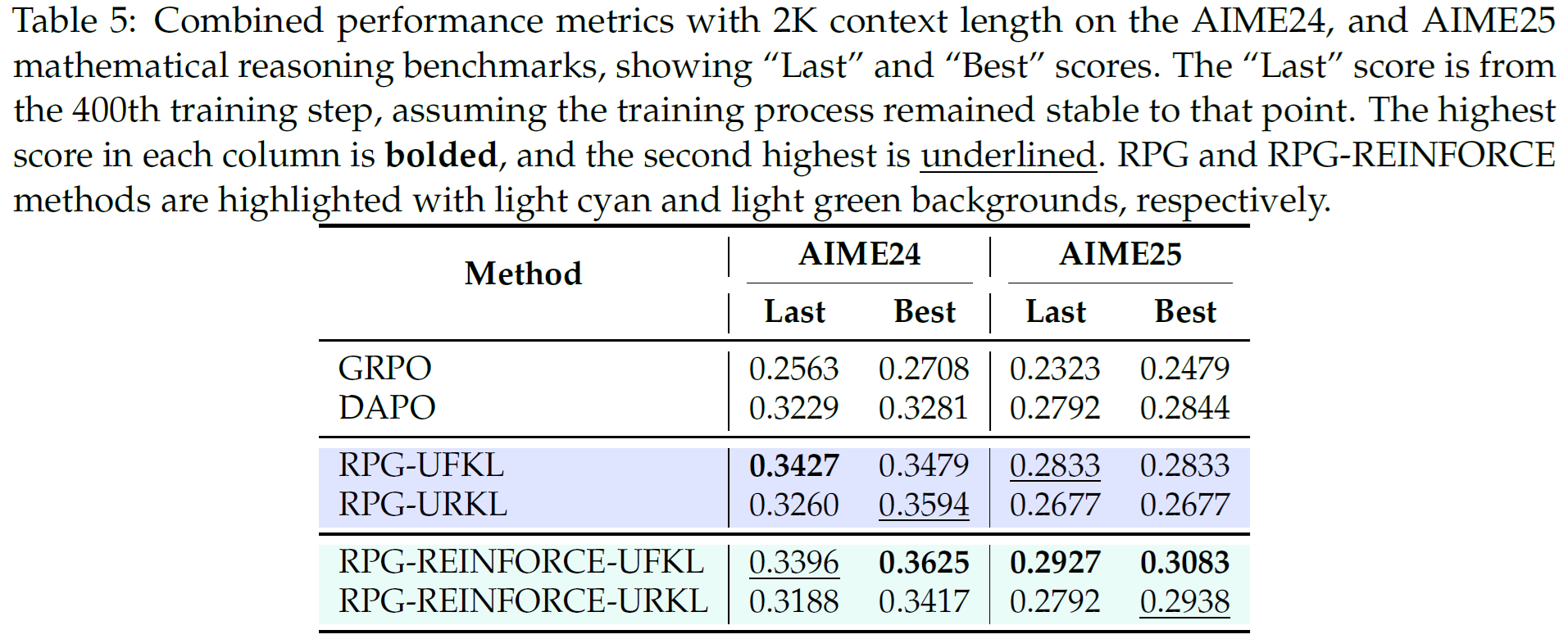
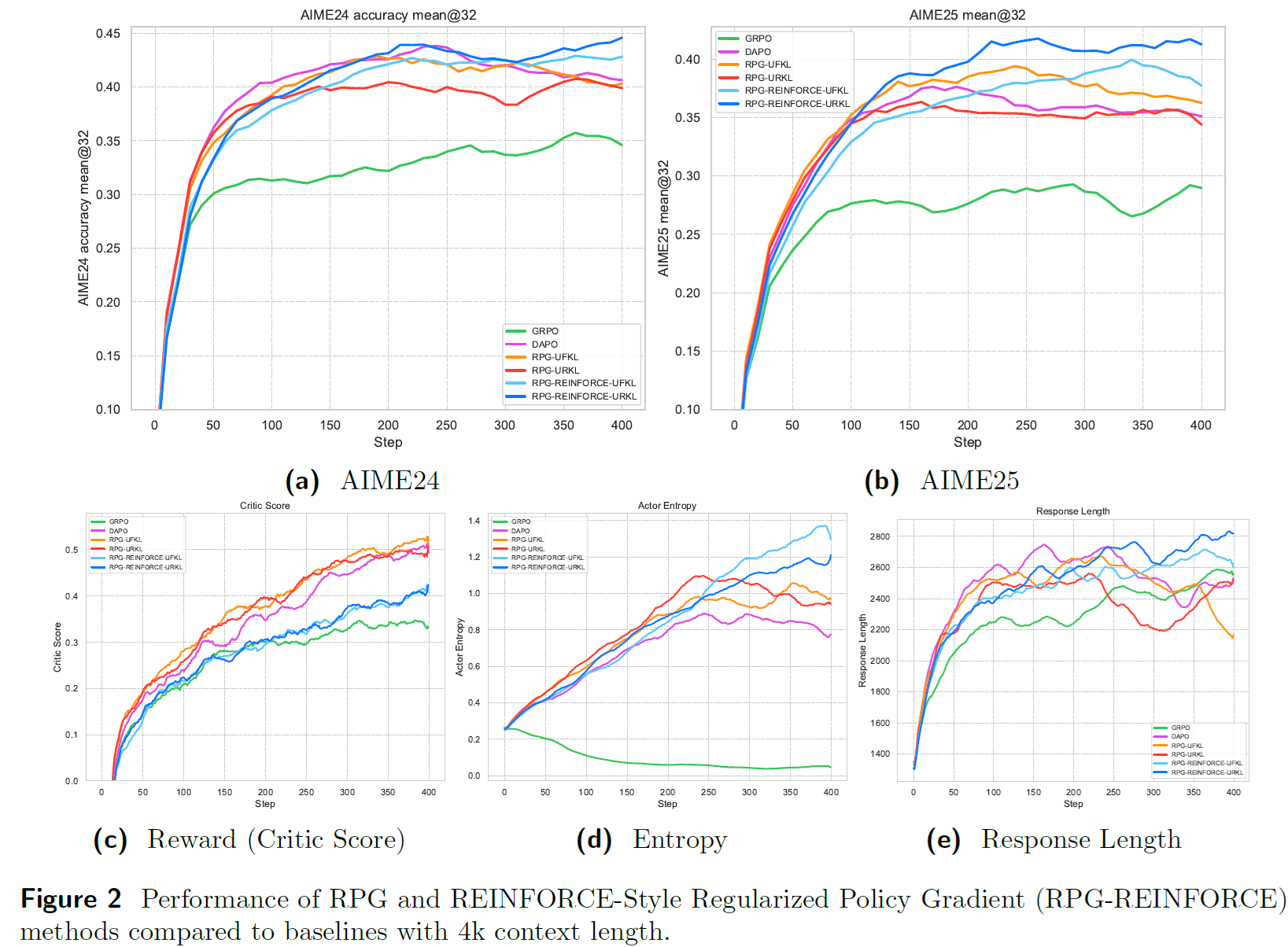
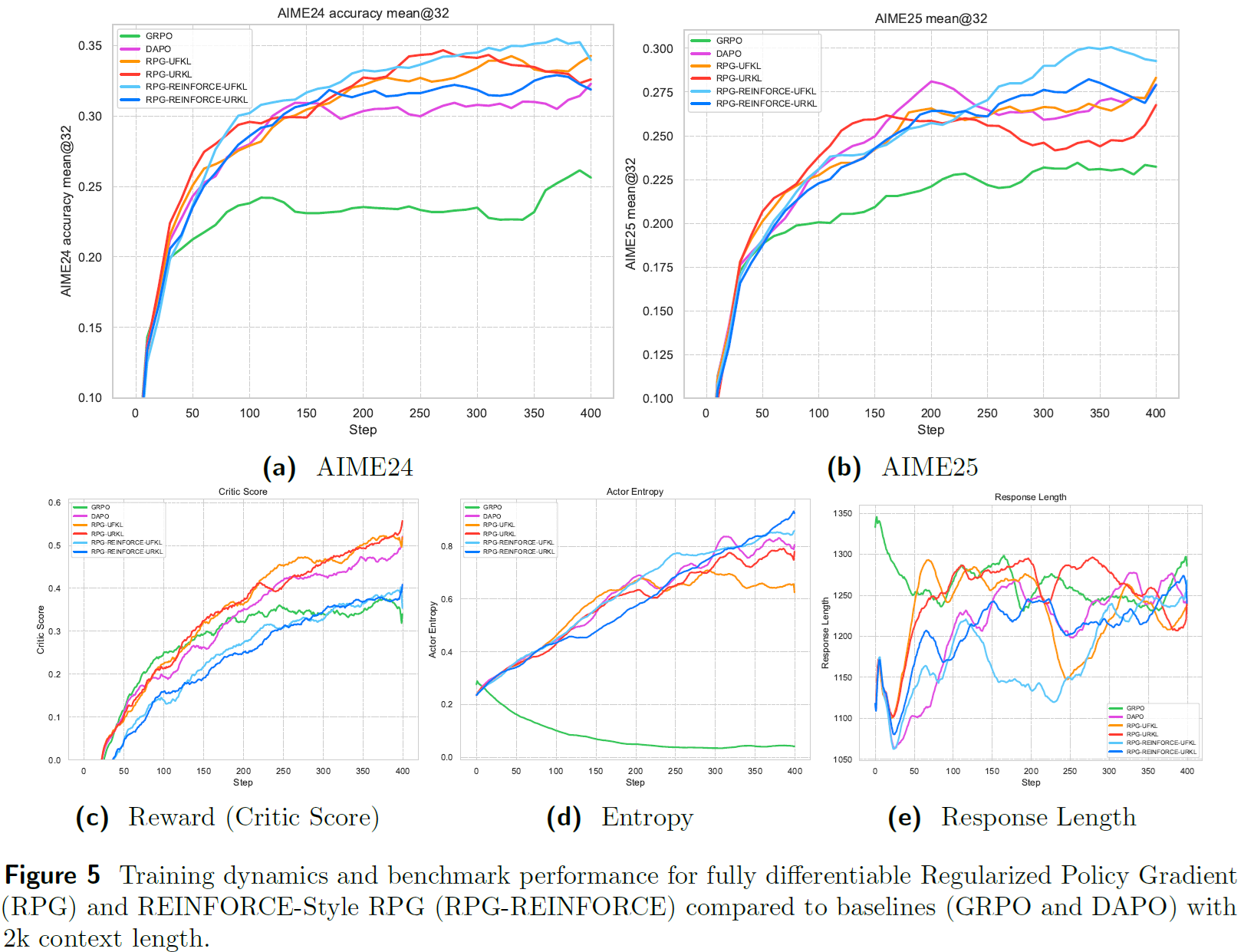
- On math reasoning, RPG-REINFORCE (with RPG-Style Clip) yields stable and scalable training and outperforms DAPO by up to +6 absolute points on AIME24/25.
Experimental Results
Fully Differentiable Surrogate Loss Functions
REINFORCE-Style Regularized Policy Gradients
Citation
If you find RPG useful, please cite:
@article{zhang2025design,
    title   = {On the Design of KL-Regularized Policy Gradient Algorithms for LLM Reasoning},
    author  = {Zhang, Yifan and Liu, Yifeng and Yuan, Huizhuo and Gu, Quanquan and Yao, Andrew C},
    journal = {arXiv preprint arXiv:2505.17508},
    year    = {2025}
}